What Are You Still Carrying?
When I let go of what I am, I become what I might be. - Lao Tzu
There are things in our lives that we keep long after we have stopped using them. A box in the basement, clothes hanging in a closet, a drawer filled with things that belonged to someone we loved, papers we have not looked at in years, or gifts we cannot bring ourselves to give away. We may know that something needs to be sorted, donated, or discarded, yet every time we think about opening that door, we find another reason to leave it for later.
It is easy to assume that holding on is about the object itself. Often, it is about much more than that.
A possession can carry a memory, a relationship, a version of ourselves, or a chapter of life that we are not quite ready to close. The physical thing simply gives those emotions somewhere to live. Letting go of it can feel like letting go of the person, experience, or identity connected to it.
I have experienced this in my own life.
In 2012, Superstorm Sandy flooded my garage on Staten Island and took away things I had held onto for years. At the time, I did not fully understand what that experience was showing me about my relationship with possessions and attachment.
Then, in 2024, my mother died, and I had to clear her apartment quickly. I filled black garbage bags with her belongings, knowing that every item carried a story. Two years later, I am still working through those bags, little by little. I am not standing outside this process telling you that I have mastered it. I am still walking it myself.
That experience has changed the way I think about letting go. It is not about becoming someone who does not care. It is about learning how to care without allowing everything we care about to become something we must continue carrying.
There is also a practical side to this. A 2026 IKEA study conducted in partnership with YouGov of 31,488 people across 31 markets found that 82% of people keep things purely for sentimental reasons, even when those items are never used or kept out of sight. The finding illustrates just how closely our possessions can become tied to memory and emotion.
So instead of asking only, “Do I need this?” There are times when a more honest question is, “What am I afraid will happen if I let this go?”
The answer may reveal something that has very little to do with the item itself. Guilt can make it difficult to part with something given to us by someone we love. Grief can make an ordinary belonging feel irreplaceable. An old possession can represent money we spent, a dream we once had, or a period of life we are not ready to leave behind. We can also become attached to the idea that we will deal with everything eventually, once there is more time, more energy, or more emotional space.
Then another year passes.
This is why willpower is not always enough. When something carries grief, guilt, shame, or emotional attachment, telling yourself to simply clean it out can miss the real issue. You may begin with the intention of clearing a closet and suddenly find yourself confronting memories you have avoided for years.
That is where our inner conversation becomes important.
In Positive Intelligence, these internal patterns are referred to as Saboteurs. The Judge can make us criticize ourselves for not dealing with something sooner. The Victim can convince us that the situation is too painful to face. The Pleaser can create guilt around letting go of something because someone else gave it to us, while the Controller can make us believe we have to handle everything perfectly before it is worth beginning.
Recognizing these patterns creates a little distance between the thought and the decision. Instead of automatically following the guilt, fear, or pressure, we can become curious about what is actually happening underneath it.
That does not mean everything has to go.
Some things deserve to stay because they genuinely hold meaning. Other things can be passed on to someone who will use them, while certain possessions may simply have completed their place in our lives. The point is not to empty every closet or create a perfectly organized home. It is to become more conscious about what we keep and why we keep it.
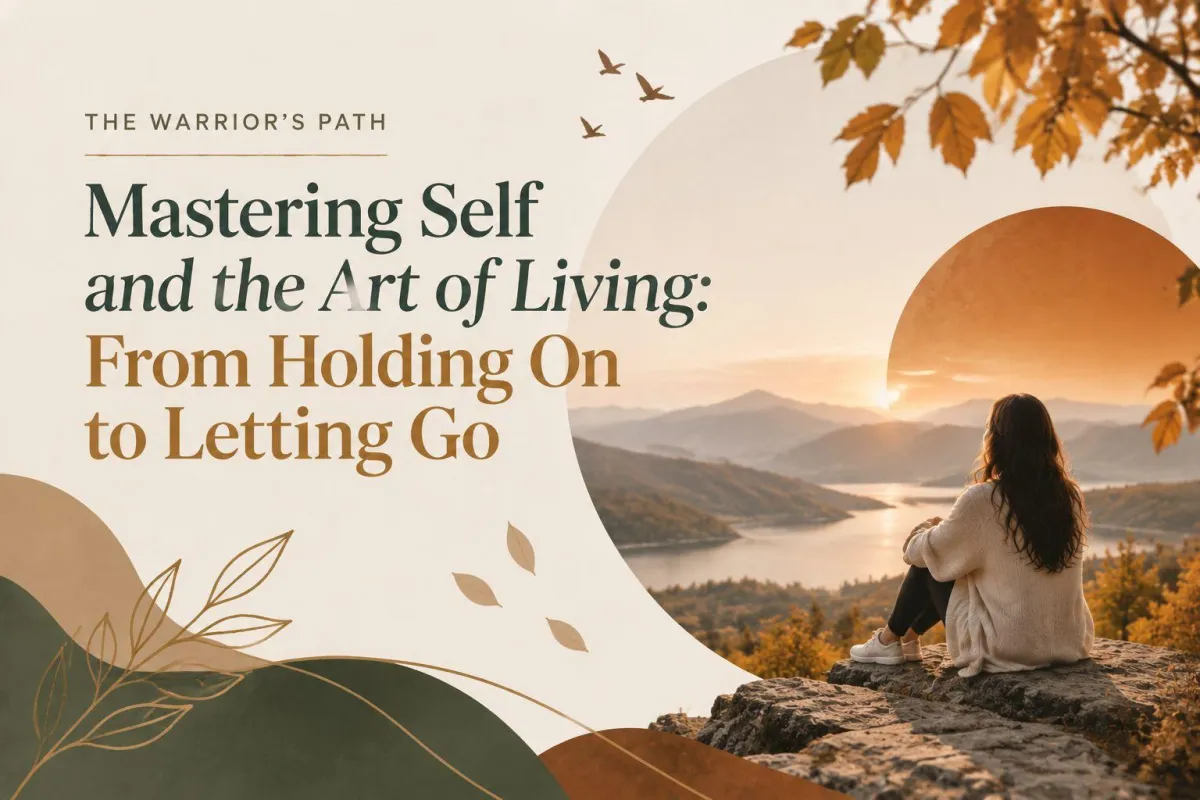
That is the heart of Mastering Self and the Art of Living: Fall, the upcoming seasonal learning experience I created around the practice of letting go. Fall naturally gives us a beautiful image for this work. Trees release their leaves as the season changes, not because those leaves were meaningless, but because their season has ended. In Traditional Chinese Medicine, fall is associated with the Metal element and the process of letting go. That seasonal connection invites us to consider what may have completed its purpose in our own lives.
The Fall experience is an 8-week small-group coaching pod limited to 10 people. We will meet live on Zoom each week and use Positive Intelligence to recognize the Saboteurs that can keep us stuck, strengthen the wiser Sage within us, and take practical steps toward release. Participants will also have access to the Positive Intelligence app for daily practices, a private pod space, and the Letting Go Gate from Traditional Chinese Medicine.
The work does not require you to transform your entire home or resolve every piece of your past. It can begin with one space you have avoided, one belonging you have struggled to release, or simply the willingness to look at your relationship with holding on from a different perspective. Because ultimately, letting go is not about rejecting the past. It is about making an honest decision about what deserves a place in your present.
The memories can remain even when the object does not. Love can remain even when we give something away. A chapter can remain part of our story without continuing to occupy every corner of our lives.
Fall reminds us that release is not the opposite of growth. It is part of it.
And perhaps the real question is not how much we can hold, but how much more room we could create by becoming intentional about what we carry.
If this work speaks to something you have been carrying, Mastering Self and the Art of Living: Fall begins with a live kickoff on Sunday, October 4 at 3 PM ET. The pod is intentionally limited to 10 people, and the first step is a free Letting Go Call, followed by a complimentary Saboteur Assessment. Learn more about the Fall experience and book your Letting Go Call here.
